The opportunity of digital learning material in Atal Tinkering Labs
Explore how digital learning material in Atal Tinkering Labs supports visual explanations, simulations, safer experimentation, & interactive STEM learning.
On this page
- What is an Atal Tinkering Lab?
- The objective of Atal Tinkering Lab
- What resources are available inside an ATL?
- ATL is already providing guidance – the opportunity is to make it more experiential
- So the opportunity is to ask what the next form of digital learning material for Atal Tinkering Labs could look like.
- That is the layer where interactive and simulation-based content becomes integral.
- Students need to understand what is happening, not only what to connect
- Safety can also become something students can see
- Teachers need flexible learning material too
- This is where we see a natural role for UnStill alongside the existing Atal Tinkering Labs (ATL) ecosystem.
- For an Atal Tinkering Lab, this could work at two levels.
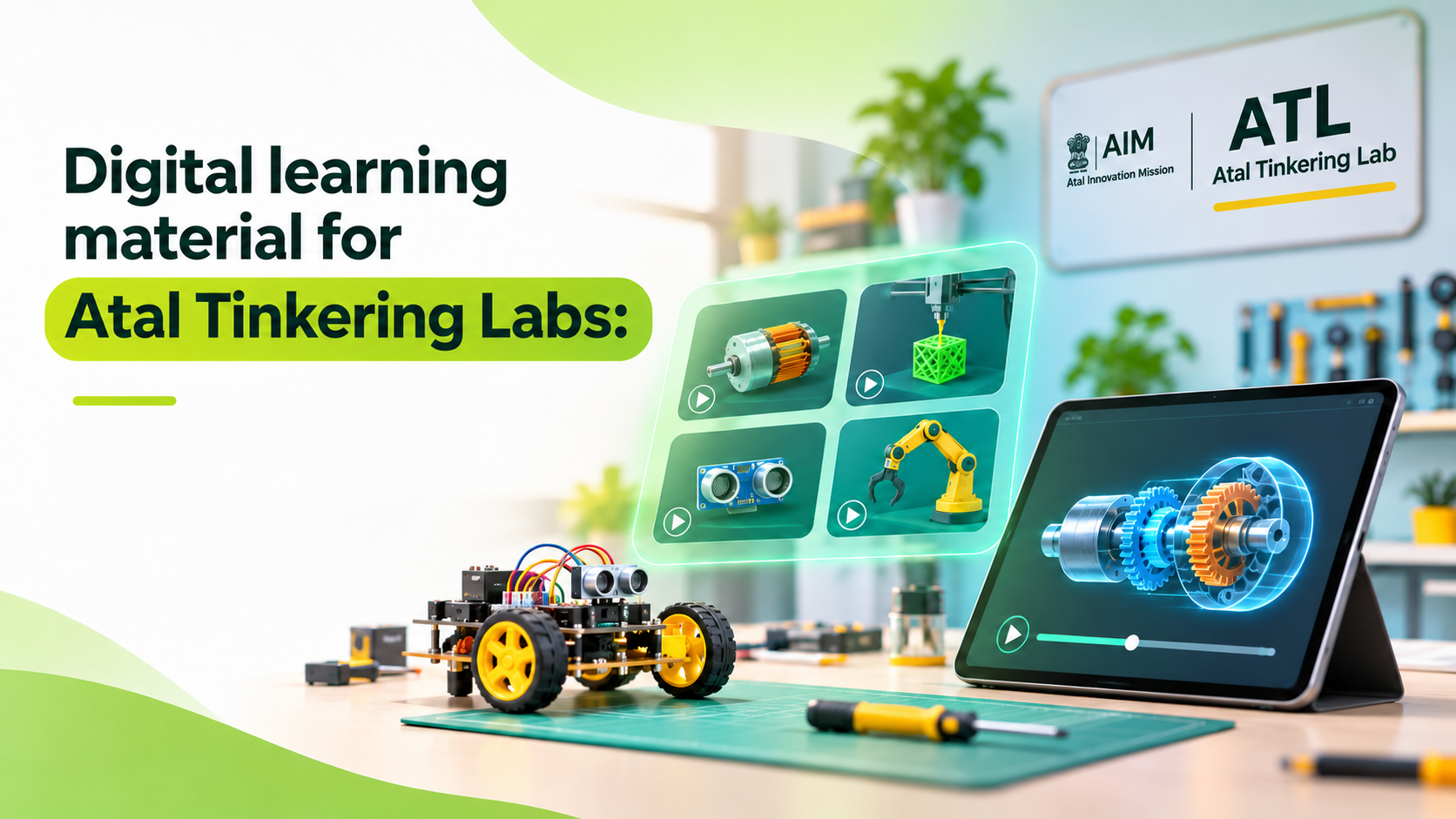
India's Atal Tinkering Lab (ATL) programme has created physical spaces where young learners can move beyond reading about science and technology and begin building, experimenting, and solving problems themselves.
Atal Tinkering Labs is part of the Atal Innovation Mission (AIM) under NITI Aayog. Their purpose is to foster curiosity, creativity, imagination, design thinking, computational thinking, adaptive learning, and physical computing among young learners. Today, AIM reports 10,000 Atal Tinkering Labs across 35 states and Union Territories, more than 1.1 crore students actively engaged, and over 16 lakh innovation projects created.
That is significant infrastructure for hands-on STEM learning. But as ATL implementation matures, there is another question worth asking:
Once the equipment is inside the lab, what helps a student truly understand what to do with it, what is happening inside it, and what they should learn from the experiment? This is where digital learning material for Atal Tinkering Labs can become an important next layer.
What is an Atal Tinkering Lab?#
An Atal Tinkering Lab is designed as a workspace where students can give shape to ideas through hands-on, do-it-yourself learning. AIM describes ATLs as environments where students can work with tools and equipment related to science, electronics, robotics, open-source microcontroller boards, sensors, 3D printers, computers, and other emerging technologies.
The philosophy is deliberately broader than a conventional science laboratory. Students are encouraged to identify problems, design solutions, build prototypes, test ideas, and develop innovation skills.
The ATL curriculum reflects that ambition. It covers areas ranging from basic electronics, mechanics, design thinking, and data visualisation to 3D printing, physical computing, the Internet of Things (IoT), artificial intelligence, Python, drones, gaming, and space-related learning. AIM's structured tinkering curriculum progresses from foundational concepts towards more advanced applications and projects.
The objective of Atal Tinkering Lab#
To teach students how to operate equipment. It is to encourage them to use technology as a way of thinking, experimenting, and solving problems.
What resources are available inside an ATL?#
The range of equipment available through the ATL ecosystem is extensive. AIM's equipment manual groups resources across areas including electronics development, robotics, IoT and sensors, rapid prototyping, and mechanical, electrical, and measurement tools. The listed resources include Arduino boards, Raspberry Pi systems, motors, breadboards, sensors, electronic components, 3D printers, multimeters, oscilloscopes, soldering equipment, measurement tools, and fabrication tools.
These resources give students an opportunity to move from theory to application. A learner studying electronics can build a circuit. Someone exploring robotics can combine sensors, motors, and code. A student learning product design can create a digital model and then turn it into a physical object using a 3D printer.
ATL is already providing guidance – the opportunity is to make it more experiential#
It is important to recognise that AIM has already developed substantial support around the ATL ecosystem. There is a dedicated ATL Equipment Manual, a structured tinkering curriculum, teacher handbooks, student resources, equipment videos, and teacher training material. AIM's teacher training modules cover areas including electronics, sensors and actuators, breadboards, Arduino, 3D printing, Raspberry Pi, tools, design thinking, and safety. There are also certified teacher-training and self-learning resources.
The ATL Guidebook itself acknowledges that ATL in-charges and students may initially be unfamiliar with some of the equipment and positions the equipment manual as a way to explain specifications, applications, project examples, and equipment use. AIM has also created video resources around ATL equipment.
So the opportunity is to ask what the next form of digital learning material for Atal Tinkering Labs could look like.#
A manual can tell a learner what a DC motor is. A video can demonstrate how it is used.
But could a student also see the motor opened up in 3D, understand what the rotor and stator are doing, watch the relationship between current and movement, change a variable, and then connect that visual understanding to the motor sitting on the ATL table?
That is the layer where interactive and simulation-based content becomes integral.#
Students need to understand what is happening, not only what to connect#
Consider a typical electronics activity. A learner may be instructed to connect an Arduino, a sensor, a resistor, and a motor in a particular configuration. They may successfully reproduce the circuit and make the motor move. That is an achievement. But deeper learning begins when the learner can explain why it moved.
What signal did the sensor produce? What did the microcontroller do with that signal? Why was the resistor needed? What changed inside the motor when current reached it? What would happen if the input were different?
Similar questions arise across ATL resources.
- A 3D printer becomes more meaningful when students can see how the nozzle, print bed, filament, motors, and layer-by-layer process work together. AIM's own equipment material explains these components and includes safety measures for use.
- A sensor becomes more meaningful when learners understand what physical quantity it detects and how that becomes a signal.
- A robotic system becomes more meaningful when students can trace the relationship between input, computation, movement, and output.
This is where visual content can complement hands-on tinkering. The learner should be able to move from: “I know how to connect this.” to: “I understand what this system is doing.”
Safety can also become something students can see#
ATL resources include equipment that needs thoughtful handling, particularly fabrication tools, soldering equipment, electrical systems, heat-producing equipment, and 3D printers. AIM explicitly includes safety within its teacher training modules, and individual equipment resources include safety guidance.
Visual and interactive learning can reinforce that preparation. Before using unfamiliar equipment, students could explore the equipment virtually, identify its parts, understand where heat or movement occurs, see the correct operating sequence, and understand what should not be touched or changed during use.
The objective is not to replace supervision or formal safety procedures. Those remain essential. The opportunity is to make safety more understandable. Instead of only reading, ‘Do not touch this part while operating’, a learner can first see which part, what it does, and why the instruction matters.
Teachers need flexible learning material too#
Teachers and ATL in-charges play a critical role in turning equipment into a meaningful learning experience. AIM has built training infrastructure around this, including certified training, training modules, self-learning resources, and mentoring programmes. Mentor India also connects ATL schools with Mentors of Change who help students practise innovation and future skills.
But the range of equipment and subjects inside an ATL is wide. One activity may involve electronics. Another may require 3D printing. The next may introduce IoT, coding, mechanical fabrication, artificial intelligence, or sensors.
It is therefore useful to think beyond a fixed library of training content towards digital learning material that teachers can adapt to the activity they are conducting.
- A teacher preparing an activity around an ultrasonic sensor, for example, could show students how the sensor emits and receives signals before they build a distance-measuring project.
- A teacher introducing a servo motor could visually demonstrate why its movement differs from a conventional DC motor.
The digital STEM content becomes a bridge between the teacher's explanation and the physical resource in front of the learner.
This is where we see a natural role for UnStill alongside the existing Atal Tinkering Labs (ATL) ecosystem.#
UnStill is an AI-powered animation and simulation engine designed to turn descriptions into visual explanations. Depending on the concept, it can create 2D and 3D scenes, movement, labels, narration, camera direction, simulations, and interactive experiences.
For an Atal Tinkering Lab, this could work at two levels.#
The first is a pre-built visual library aligned with ATL equipment and learning activities.#
Students could select the resource they are about to use – a motor, sensor, Arduino board, 3D printer, mechanical component, or another lab tool – and explore a visual explanation of what it is, how it works, how its parts relate, what happens during operation, and what they should observe during the physical activity.
The second possibility is enabling the UnStill engine within the learning environment.#
A teacher could ask:
- Show how an ultrasonic sensor measures distance.
- Explain what happens inside a DC motor when current flows.
- Show how the layers form during FDM 3D printing.
The opportunity is to make the ATL more responsive to curiosity rather than limiting digital support to a predetermined sequence of content.
UnStill is designed to strengthen what Atal Tinkering Labs and other STEM education initiatives have already enabled through hands-on learning and experimentation.#
Schools and institutions can enhance their existing STEM or tinkering labs with pre-built UnStill content aligned to STEM concepts, or enable the UnStill engine so students and teachers can create their own visual explanations, simulations, and learning experiences around the topics they are exploring. The aim is to make STEM learning more visual, interactive, and connected to the experiments students are already doing. To explore UnStill in more detail or book a demo, you can contact us at +918700506796 or share your details here.