What is STEM education and why do STEM labs need more than equipment?
Learn what STEM education is, why STEM labs are needed, and how visual content, and guided experimentation can make hands-on learning more meaningful.
On this page
- Need of STEM labs
- STEM labs need more than tools – they need understanding
- This is where digital content for STEM labs can become an important learning layer.
- Let’s work to connecting visual learning with physical experimentation
- Where UnStill can contribute to STEM education
- Two ways UnStill can support a STEM lab initiative.
- Plus, UnStill is designed to make STEM content easier to deploy
- We envision STEM labs that enable meaningful learning
STEM stands for Science, Technology, Engineering, and Mathematics, but STEM education is much more than teaching these four subjects next to one another. Its real value lies in bringing them together so that students can solve problems, test ideas, build things, observe outcomes, and understand how concepts work in the real world.
A student may learn the theory of electricity in science, use mathematics to calculate resistance, apply engineering principles to design a circuit, and use technology to measure or control the result. That is where STEM education becomes different from conventional subject-based learning. The learner is no longer only absorbing information. They are using knowledge from different areas to understand and solve something.
UNESCO describes STEM education as an interdisciplinary approach that integrates science, technology, engineering, and mathematics to support critical thinking, problem-solving, creativity, and innovation.
This approach is increasingly important because many scientific and technical concepts become meaningful only when students are able to work with them. Reading about circuits, mechanical systems, chemical reactions, sensors, or robotics gives learners the foundation, but experimentation helps them see how those ideas behave outside the textbook.
Need of STEM labs#
A STEM lab gives students a physical space where concepts can become experiences. Instead of only reading how a motor works, students can assemble one. Instead of learning programming only through syntax, they can programme a robot or control a sensor. Instead of memorising a scientific result, they can perform an experiment, observe the outcome, and ask why it happened.
India's Atal Tinkering Lab (ATL) initiative reflects this thinking. The Atal Innovation Mission describes these labs as spaces designed to encourage curiosity, creativity, imagination, design thinking, computational thinking, and physical computing among students. The programme has established 10,000 Atal Tinkering Labs and reports engagement from more than 1.1 crore students.
Initiatives like these are important because access matters. Students need equipment, tools, kits, spaces, and opportunities to experiment. But once that infrastructure is in place, another question becomes equally important: does having the equipment automatically mean that students understand what they are doing with it? This is where the conversation around STEM education needs to go further.
STEM labs need more than tools – they need understanding#
A student may have a circuit board in front of them without fully understanding how current is moving through it. They may be performing a chemical experiment while finding it difficult to picture what is happening between the particles. They may assemble a mechanical system correctly by following instructions without understanding why one component causes another to move.
None of this means the equipment is less valuable. It means the learning experience around the equipment matters just as much.
Hands-on learning becomes far more meaningful when students know what they are trying to observe. Before changing a variable, they should have some idea of what might change as a result. Before carrying out a procedure, they should understand why that procedure matters. Before using unfamiliar equipment, they should be able to visualise what is happening inside the system.
This is where digital content for STEM labs can become an important learning layer.#
The role of digital content should not simply be to place another video beside the equipment. It should help students understand the parts of an experiment that are difficult or impossible to observe directly.
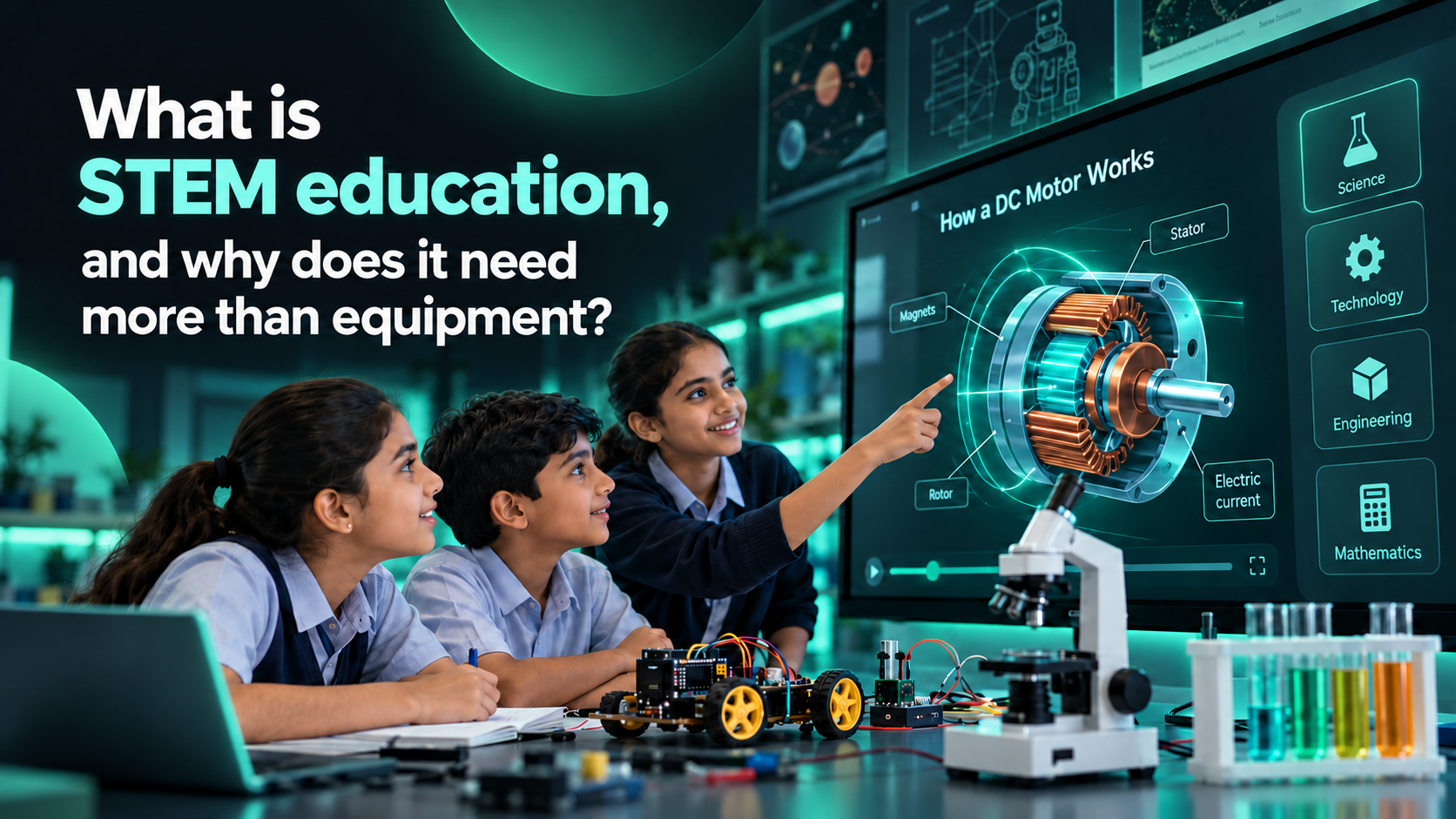
When students connect a circuit, they can see whether a bulb lights up, but they cannot watch electrons move through the conductor. When they perform a chemical reaction, they may observe a colour change, gas formation, or temperature change, but they cannot see atoms and molecules interacting. When they use a motor, they can watch it rotate, but magnetic fields and electromagnetic forces remain invisible.
A visual simulation makes those hidden processes easier to understand. It shows the learner what is happening underneath the observable result and helps them build a mental model before they begin experimenting.
Let’s work to connecting visual learning with physical experimentation#
The stronger opportunity for STEM labs is therefore not to choose between digital learning and physical experimentation. The two can support each other.
Before an experiment, students can use visual content to understand the system, identify its components, see how they interact, and form a prediction about what might happen. They can then move to the physical lab, perform the activity, observe what actually happens, and compare the result with their expectation.
Afterwards, they can return to the visual model to understand why the outcome occurred. This creates a much stronger learning journey: visualise, predict, experiment, observe, question, and understand.
The experiment remains central, but it is no longer an isolated activity. It becomes part of a cycle in which students continually connect theory with observation.
This matters because the purpose of STEM education should help students develop the habit of asking better questions. Why did this happen? What happens if this variable changes? Why did our result differ from what we expected? Could this system work differently? Those questions are where experimentation becomes learning.
Where UnStill can contribute to STEM education#
UnStill is designed to turn a written description into a visual explanation that can include 2D and 3D scenes, animation, narration, simulations, labels, camera movement, and interactive elements. For STEM labs, this creates the possibility of connecting the concept directly to the activity students are about to perform.
A teacher could describe how a particular electric motor works, ask for a visual explanation of electron transfer during ionic bonding, show how pressure changes inside a hydraulic system, or create a simulation around the exact experiment planned for that day's lesson.
Two ways UnStill can support a STEM lab initiative.#
- The first is through a pre-built library of STEM content aligned with common curriculum topics, experiments, and lab equipment. Students could explore this content before performing an activity or revisit it afterwards when they want to understand the result more deeply.
- The second is through the UnStill engine itself, where teachers, lab coordinators, or eventually students can create visual explanations and simulations around the questions they are exploring.
This ability to create content around the actual learning environment is important. STEM education works best when curiosity leads the learner somewhere. If a student asks what will happen when a variable changes, the lab should ideally help them see the idea, test it, and then understand the result.
Plus, UnStill is designed to make STEM content easier to deploy#
STEM initiatives also have to work beyond a single well-connected classroom. Schools and education programmes operate under very different conditions, particularly when connectivity, devices, and local storage are considered. This is another area where the way UnStill is designed becomes relevant.
UnStill ships the description of the animation rather than the pixels. The visual portion of a scene can therefore remain extremely lightweight compared with a conventional pre-rendered video. This creates possibilities for enabling STEM content in offline or low-connectivity environments without requiring a large video file for every experiment or topic.
A school could therefore work with a pre-loaded content library, while another institution with stronger connectivity could also enable the engine so teachers and learners can generate new visual explanations.
The underlying objective remains the same: make the learning experience accessible without making the infrastructure unnecessarily heavy.
We envision STEM labs that enable meaningful learning#
Equipment is fundamental to STEM education, but its value grows when learners understand what they are experimenting with.
A strong STEM lab brings together physical equipment, teacher guidance, visual understanding, experimentation, and curiosity. Students should be able to see the concept, make a prediction, test it, observe the result, and understand why it happened.
This is where we see UnStill contributing to STEM lab initiatives in India and globally – through pre-built visual STEM content, lightweight offline-ready experiences, and an engine that can help teachers and students create explanations around their own experiments.