What is chemical bonding? Learn ionic, covalent, and metallic bonds with a 3D animation
Learn what chemical bonding is, why atoms form bonds, and how ionic, covalent, and metallic bonding work, with clear examples and a 3D animation by UnStill.
On this page
- What is a chemical bond?
- Why do atoms form bonds?
- What are the three main types of chemical bonding?
- Ionic bonding – when electrons are transferred
- Covalent bonding – when atoms share electrons
- Metallic bonding – when electrons are delocalised
- What is the difference between ionic, covalent, and metallic bonding?
- Ionic bonding
- Covalent bonding
- Metallic bonding
- Why is chemical bonding important?
- Why can chemical bonding feel difficult at first?
- Learn chemical bonding with a 3D animated video
- Why UnStill?
From the water we drink to the salt in our food and the metals used in buildings, almost every material around us exists because atoms are held together in some way. That is the idea behind chemical bonding.
Chemical bonding is one of the most important topics in chemistry because it helps explain how substances form, why they have different structures, and why they behave differently. It also answers some very common beginner questions: What is a chemical bond? Why do atoms form bonds? What is the difference between ionic and covalent bonding? And how do metals stay together?
If you have ever wondered why water behaves so differently from table salt, or why metals conduct electricity while many other substances do not, chemical bonding is where those answers begin. This article explains the basics of chemical bonding in a simple, step-by-step way. At the end, you can also explore the topic through a 3D animated video created with UnStill, so you can move from reading the concept to actually seeing it happen.
What is a chemical bond?#
A chemical bond is the attractive force that holds atoms, or ions, together in a substance. At first, that may sound abstract, but the idea is quite simple. Atoms do not usually combine randomly. They form bonds because bonding can create a more stable arrangement. In many cases, that stability is connected to the arrangement of electrons, especially the electrons in the outermost shell, also called valence electrons.
So when we ask, **“What is chemical bonding in simple words?”**A good answer is this: Chemical bonding is the way atoms or ions stay joined together to form molecules, compounds, and larger structures.
Why do atoms form bonds?#
Atoms form bonds because bonding can lower their energy and produce a more stable arrangement. This is why electrons matter so much in bonding. The outer electrons of an atom play the biggest role in deciding whether an atom is likely to share electrons, transfer electrons, or become part of a metallic structure.
You do not need to think of this as atoms ‘wanting’ something in a human sense. It is better to think of chemical systems moving towards greater stability. That is why different atoms bond in different ways. The way they bond depends on their electron arrangement and on how strongly they attract electrons.
What are the three main types of chemical bonding?#
For most school-level and beginner chemistry, the three main strong chemical bonds are:
- ionic bonding
- covalent bonding
- metallic bonding
These three types are the core of chemical bonding, and each one works differently.
Ionic bonding – when electrons are transferred#
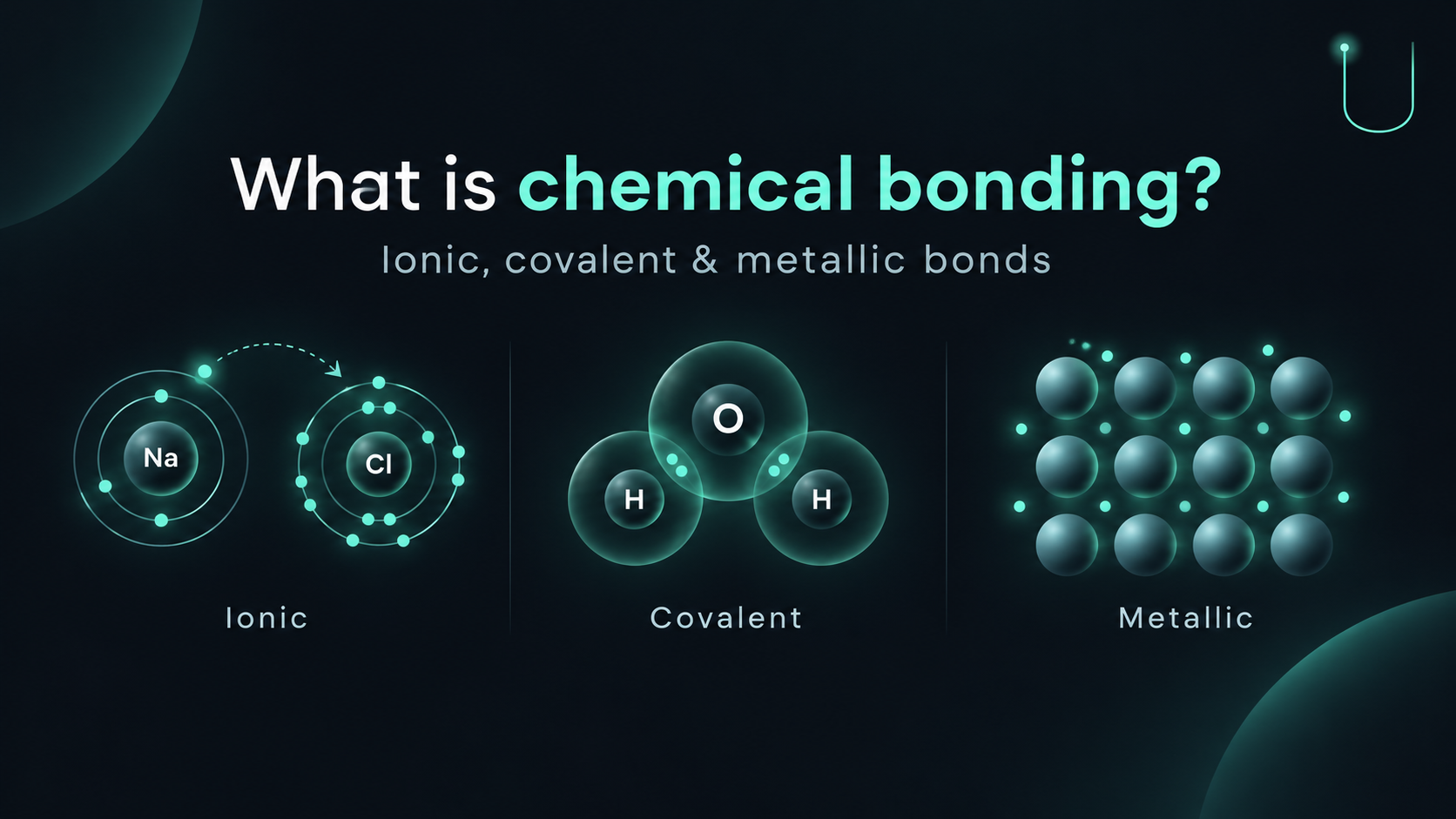
An ionic bond forms when electrons are transferred from one atom to another. This usually happens between a metal and a non-metal. The metal atom loses one or more electrons and becomes a positively charged ion, while the non-metal gains those electrons and becomes a negatively charged ion. The oppositely charged ions then attract each other strongly.
A classic example is sodium chloride (NaCl), which is common table salt.
- A sodium atom loses one electron.
- A chlorine atom gains that electron.
- Sodium becomes a positive ion.
- Chlorine becomes a negative ion.
- The electrostatic attraction between them forms an ionic bond.
So if someone asks, **“How are ionic bonds formed?”**The simple answer is: Ionic bonds form when electrons are transferred and oppositely charged ions attract each other.
Ionic compounds usually form giant ionic lattices, not single isolated molecules. This helps explain why many ionic substances have high melting points and why they conduct electricity when molten or dissolved in water, but not when solid.
Covalent bonding – when atoms share electrons#
A covalent bond forms when atoms share pairs of electrons. This usually happens between non-metal atoms.
In covalent bonding, the atoms are held together because the shared electrons are attracted to the nuclei of both atoms. Rather than one atom fully taking electrons from another, the atoms share them.
A familiar example is water (H₂O). One oxygen atom forms covalent bonds with two hydrogen atoms. Each hydrogen shares electrons with oxygen, helping to hold the molecule together. Another simple example is oxygen gas (O₂), where two oxygen atoms share electrons with each other.
So if someone asks, “What is a covalent bond with an example?”, you could say: A covalent bond is a bond formed when atoms share electrons, such as the bonds between hydrogen and oxygen in water.
Covalent substances can exist as small molecules, such as water or carbon dioxide, or as giant covalent structures, such as diamond. Their properties depend on their structure, which is why not all covalent substances behave in the same way.
Metallic bonding – when electrons are delocalised#
A metallic bond holds metal atoms together in a metallic structure. In metals, the outer electrons become delocalised, which means they are not tied to one atom. Instead, they can move through the whole structure. This creates an attraction between:
- the positive metal ions, and
- the delocalised electrons around them.
That attraction is what holds the metal together. This model helps explain several important properties of metals:
- they conduct electricity,
- they conduct heat,
- they can often be bent or shaped, and
- Many have high melting and boiling points.
So if someone asks, “What is metallic bonding?”, a simple answer is: Metallic bonding is the attraction between positive metal ions and a sea of delocalised electrons.
What is the difference between ionic, covalent, and metallic bonding?#
This is one of the most searched questions around the topic, so it helps to put the differences clearly.
Ionic bonding#
- electrons are transferred
- usually between a metal and a non-metal
- forms positive and negative ions
Covalent bonding#
- electrons are shared
- usually between non-metals
- forms molecules or giant covalent structures
Metallic bonding#
- electrons are delocalised
- occurs in metals
- forms giant metallic structures
That difference in how electrons behave is what gives different substances their different properties.
Why is chemical bonding important?#
Chemical bonding does much more than explain how atoms stick together. It helps explain:
- why some substances dissolve in water while others do not,
- why some substances conduct electricity,
- why some have high melting points and others have low ones,
- why metals are flexible,
- why salt forms a crystal lattice, and
- why water exists as a molecule with its own particular behaviour.
In other words, bonding helps us move from what a substance is made of to how that substance behaves.
This is why chemical bonding is such a foundational topic in chemistry. Once you understand bonding, many other topics become easier to follow.
Why can chemical bonding feel difficult at first?#
Chemical bonding often feels difficult because it asks you to think at a very small scale. You are trying to imagine atoms, electrons, ions, sharing, transfer, attraction, and structure, all at the same time. A textbook paragraph can explain those ideas, but it can still be hard to picture what is actually happening.
That is why visual learning can be especially helpful here. For example:
- in ionic bonding, it helps to see an electron move from one atom to another,
- in covalent bonding, it helps to see shared electron pairs between atoms,
- in metallic bonding, it helps to visualise a structure of positive ions surrounded by mobile electrons.
Once you can see those differences, the topic becomes much easier to understand.
Learn chemical bonding with a 3D animated video#
To make this concept easier to follow, we have also created a 3D animated chemical bonding video with UnStill. The animation helps show:
- what a chemical bond is,
- why atoms form bonds,
- how ionic bonding works,
- how covalent bonding works,
- how metallic bonding works, and
- how these bonding types help form the substances we use every day.
Why UnStill?#
Text helps you understand the explanation, while animation helps you see the process, structure, and relationships more clearly. If you are a student preparing for GCSE Chemistry, IGCSE, Class 11 Chemistry, or you simply want to understand the basics better, this combination of text and visual explanation can make the topic much easier to grasp.