How does carbon capture and storage (CCS) work? Learn the process with a 3D animated video
Learn how carbon capture and storage works, from CO₂ capture and compression to transport and underground geological storage, with a 3D animation.
On this page
- One way to reduce those emissions is to capture the carbon dioxide before it reaches the atmosphere. This process is known as carbon capture and storage (CCS).
- What is carbon capture and storage?
- Let us look at each stage of carbon capture and storage more closely.
- What happens to CO₂ once it is underground?
- Why is carbon capture important?
- Cement is a good example.
- Which companies are working on carbon capture and storage?
- Heidelberg Materials
- SLB Capturi
- Equinor and Northern Lights
- How widely is CCS being used today?
- See how carbon capture and storage works visually
- We created a visual explanation of how carbon capture and storage works using UnStill. Watch the carbon capture and storage animation created with UnStill
Carbon dioxide (CO2) is produced by many industrial activities, including cement production, steelmaking, chemical manufacturing, and some forms of power generation. In many of these processes, reducing emissions is difficult because carbon dioxide is created not only by burning fuel, but also by the chemical reactions involved in making the product itself.
One way to reduce those emissions is to capture the carbon dioxide before it reaches the atmosphere. This process is known as carbon capture and storage (CCS).#
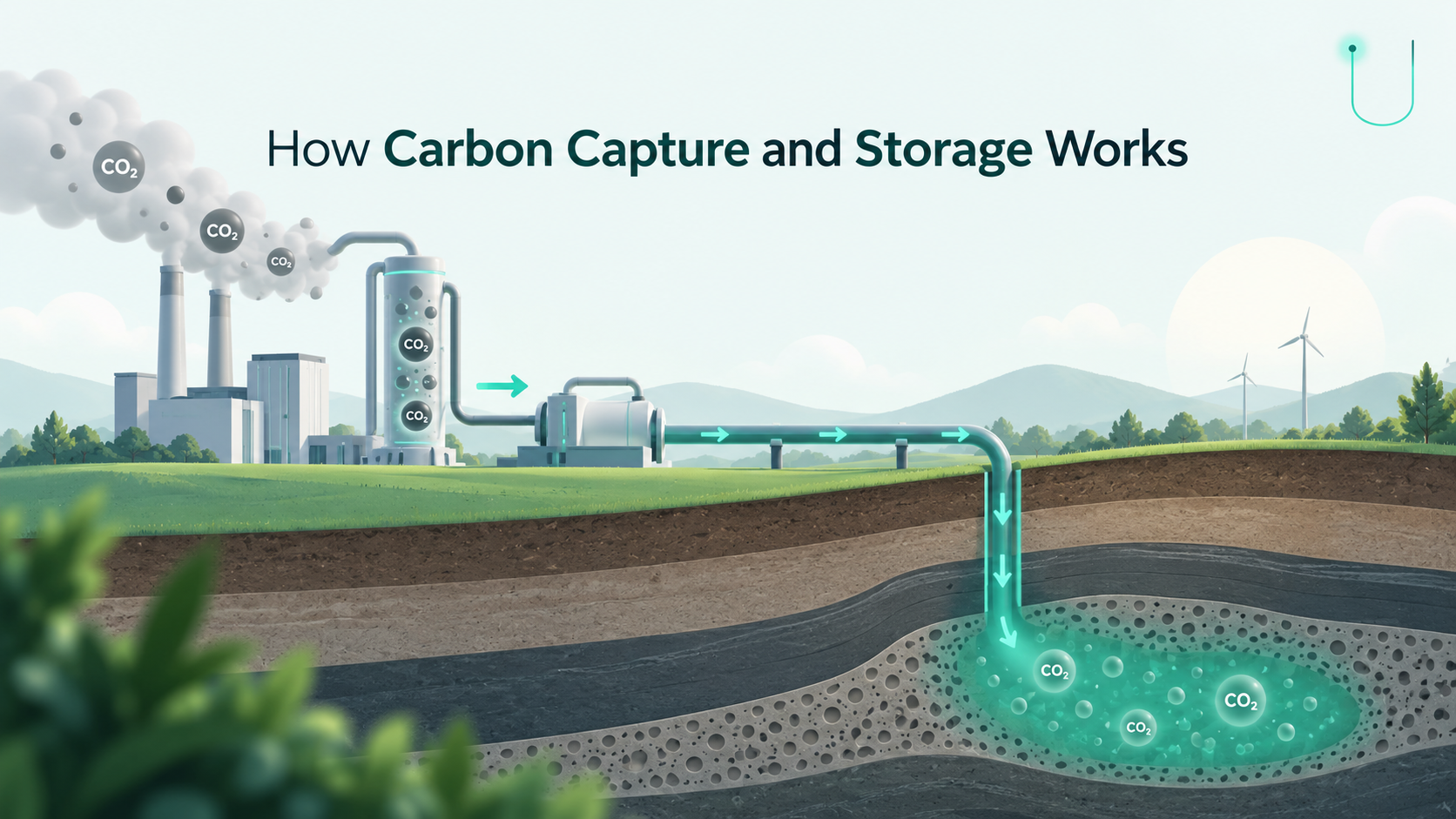
CCS works by separating carbon dioxide from an industrial gas stream, compressing it, transporting it, and storing it deep underground in suitable geological formations.
So, yes – we can capture carbon dioxide before it enters the atmosphere. But doing this at industrial scale requires a complete chain of technologies working together, from the capture plant to the underground storage site.
What is carbon capture and storage?#
Carbon capture and storage is a group of technologies designed to prevent large quantities of carbon dioxide from being released into the atmosphere. The process is mainly used, or being developed for use, at large industrial sources where significant amounts of CO₂ are produced in one location. This includes sectors such as:
- cement,
- iron and steel,
- chemicals,
- hydrogen production,
- waste-to-energy, and
- some power generation.
The International Energy Agency (IEA) identifies carbon capture, utilisation, and storage as particularly relevant for sectors such as cement, steel, and chemicals because some of their emissions are difficult to eliminate through renewable electricity or fuel switching alone. The simplest way to think about CCS is as a three-part process: capture the CO₂ → transport it → store it underground
Let us look at each stage of carbon capture and storage more closely.#
Step 1 – How is carbon dioxide captured?#
The first stage is separating carbon dioxide from the gases produced by an industrial facility. One common method is post-combustion capture. After fuel is burned, the exhaust gas can contain carbon dioxide along with nitrogen, water vapour, and other gases. The exhaust passes through a capture system where CO₂ is separated from the rest of the gas stream.
A widely used approach involves an amine-based solvent. The gas enters an absorber, where the amine liquid binds with the carbon dioxide. The CO₂-rich liquid is then moved to another part of the system and heated. Heating releases the concentrated CO₂ from the solvent. The solvent can then be reused, while the separated carbon dioxide moves to the next stage.
This is important because the visible white plume above an industrial facility is often largely condensed water vapour. Carbon dioxide itself is colourless and invisible, so capture happens inside the process rather than by simply collecting the visible plume.
There are also other capture methods, including pre-combustion capture and oxy-fuel combustion, depending on the industrial process.
Step 2 – What happens after the CO₂ is captured?#
Once the carbon dioxide has been separated, it needs to be made easier to transport. The captured CO₂ is therefore compressed. At high pressure, carbon dioxide becomes much denser, meaning a large amount can be transported in a relatively compact form. From there, it can move to a storage site through infrastructure such as:
- pipelines, or
- specialised ships.
The transport method depends on factors such as distance, geography, storage location, and the amount of carbon dioxide being handled.
This stage is becoming increasingly important as CCS projects move towards shared transport and storage networks, where several industrial facilities can send their captured CO₂ to the same geological storage system.
Step 3 – Where is carbon dioxide stored?#
The final stage is geological storage. The compressed carbon dioxide is injected deep underground into porous rock formations that can hold it within tiny spaces in the rock. These storage formations are usually located hundreds of metres to several kilometres below the surface and are covered by layers of low-permeability rock that act as a seal. Possible storage locations include deep saline formations and depleted oil and gas reservoirs.
The objective is not simply to place CO₂ underground. A suitable storage site has to be carefully studied to understand its geology, capacity, pressure behaviour, and ability to contain carbon dioxide over long periods. After injection begins, the storage site also needs to be monitored.
What happens to CO₂ once it is underground?#
Carbon dioxide does not rely on only one mechanism to remain stored. Several processes work together.
- Structural trapping occurs when an impermeable cap rock prevents the CO₂ from moving upwards.
- Residual trapping happens when small amounts of carbon dioxide become immobilised inside tiny pores in the rock.
- Dissolution trapping occurs when some of the CO₂ dissolves into the salty water already present underground.
- Over longer periods, mineral trapping can also occur. Dissolved CO₂ can react with minerals in the surrounding rock and become incorporated into stable mineral forms.
The importance and speed of each process depend on the geology of the particular storage site.
Why is carbon capture important?#
CCS is especially relevant where emissions are difficult to avoid through other methods.
Cement is a good example.#
A significant part of cement-production emissions comes from the chemical conversion of limestone into clinker. Those emissions remain even if the kiln itself uses lower-carbon energy.
This is why CCS is frequently discussed as an important decarbonisation route for cement and other hard-to-abate industries. The IEA notes that technologies such as carbon capture have an important role alongside energy efficiency, electrification, renewable energy, and other industrial decarbonisation measures.
This does not mean CCS is a replacement for renewable energy or energy efficiency. It is better understood as one part of a wider emissions-reduction strategy.
Its usefulness depends on the industry, the source of emissions, the capture rate, the energy required to operate the system, transport infrastructure, storage geology, cost, and long-term monitoring.
One of the best-known examples of geological carbon storage is the Sleipner project in the North Sea.#
CO₂ separated from natural gas has been injected beneath the seabed there since 1996. Sleipner became an important early example of how carbon dioxide could be separated, injected into a deep geological formation, and monitored over time. Norway has continued to develop this area.
A more recent example is Northern Lights, a large CO₂ transport and storage project backed by Equinor, Shell, and TotalEnergies. In August 2025, Northern Lights announced that its first CO₂ volumes had been successfully injected and stored beneath the North Sea. This is significant because Northern Lights is designed to receive captured CO₂ from different industrial sources rather than serving only one facility.
Which companies are working on carbon capture and storage?#
CCS is now being developed across several industries and regions, and a number of major companies are involved in different parts of the process.
Heidelberg Materials#
In June 2025, Heidelberg Materials opened its Brevik CCS facility in Norway, described by the company as the world's first industrial-scale CCS facility in the cement industry.
The plant is designed to capture around 400,000 tonnes of CO₂ per year from cement production. This is particularly important because cement is one of the industries where process emissions are difficult to eliminate.
SLB Capturi#
SLB Capturi develops modular carbon-capture systems for industrial facilities.
Its projects include the Brevik cement plant, Norway's Hafslund Celsio waste-to-energy project, and Denmark's Ørsted Kalundborg CO₂ Hub. Some of these projects are designed to capture hundreds of thousands of tonnes of CO₂ annually.
Equinor and Northern Lights#
Equinor is one of the companies involved in Northern Lights, alongside Shell and TotalEnergies. Northern Lights provides transport and permanent geological storage infrastructure for CO₂ captured at industrial facilities across Europe.
These examples show that CCS is an entire chain involving capture equipment, transport systems, geological engineering, injection wells, and long-term monitoring.
How widely is CCS being used today?#
According to the Global CCS Institute's 2025 assessment, 77 CCS projects were operating globally, with another 47 under construction. The broader project pipeline included hundreds more projects in different stages of development. That growth does not mean all the technical, economic, and policy challenges have been solved.
CCS projects can be expensive, capture systems consume energy, suitable storage sites must be carefully assessed, and large transport networks may be required. But the increase in operational projects shows that CCS is moving beyond laboratory research into real industrial deployment.
See how carbon capture and storage works visually#
The process becomes much easier to follow once you can see the full journey of the carbon dioxide. You can watch the CO₂ separate from an industrial gas stream, move through the capture system, become compressed, travel towards a storage site, and finally enter a deep underground geological formation.
We created a visual explanation of how carbon capture and storage works using UnStill. Watch the carbon capture and storage animation created with UnStill#
The value of combining text with visual learning is that each format can do a different job. The article can explain the terminology, the science, and why each stage matters. The animation shows where the CO₂ moves, how the stages connect, and what happens underground.