How can an AI educational tool turn complex ideas into simple visual explanations?
Discover how an AI educational tool can turn complex ideas into animations, simulations, narrated explanations, and interactive visual learning experiences.
On this page
Some ideas are difficult to explain because understanding them requires more than knowing the definition. You need to see what moves, what changes, what connects, and what happens next.
Think about how a helicopter changes direction, why a planet speeds up at certain points in its orbit, or how gradient descent gradually finds a better fit for a machine-learning model. You can explain each of these in words, but the learner still has to build much of the process in their head.
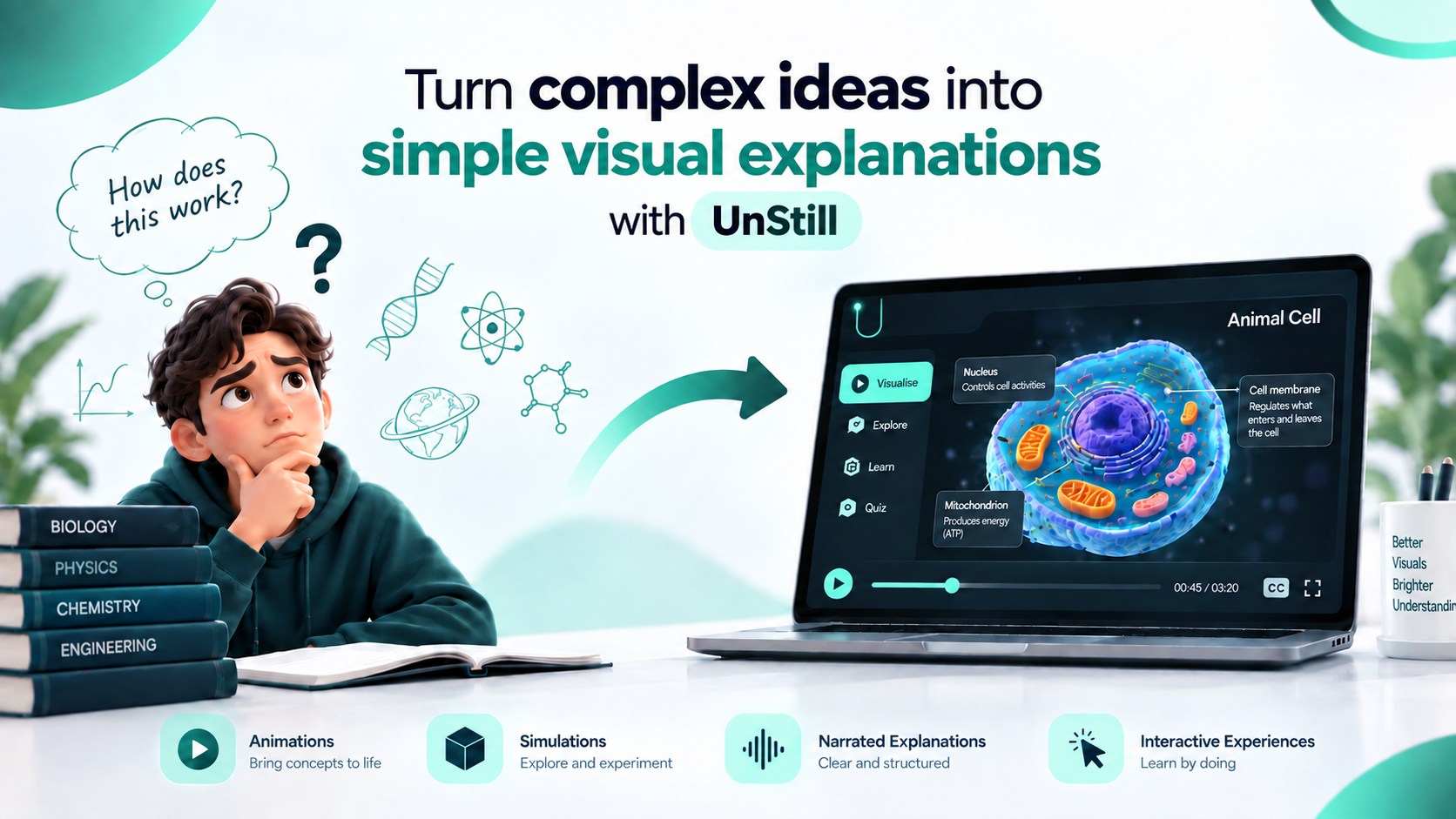
This is where an AI educational tool can do something more useful than simply generate another answer. It can take an idea and turn it into an animation, simulation, narrated explanation, or interactive experience that makes the underlying process easier to see.
This is also becoming an important direction for AI in education. Researchers and educators are increasingly exploring how generative artificial intelligence (AI) can help create guided simulations and interactive learning experiences from natural-language instructions, without requiring educators to build everything from scratch.
It starts by understanding what needs to be shown#
Turning a difficult idea into a good visual explanation is not simply about converting a paragraph into colourful graphics.
The first question is: What does the learner actually need to see?
If you are explaining how an escalator works, the important parts may be the movement of the steps, the chain mechanism, and how each step remains level as it travels around the track. If you are explaining an orbit, the important part may be how position, velocity, and gravity interact over time.
A useful AI educational tool therefore needs to move beyond the topic itself and understand its structure. What are the important objects? Which relationships matter? What happens first? What changes over time? Which parts need a label, explanation, or closer view?
Once those decisions are made, the visual becomes more than an illustration. It becomes part of the explanation itself.
How UnStill turns a written idea into motion#
With UnStill, the process starts with a written description. The engine can create a scene containing the objects, animations, camera movements, labels, narration, and timeline needed to explain the idea.
There is an important difference in how this works. UnStill does not fundamentally ship a recording of the animation. It ships the description of the animation.
That means the underlying scene remains structured rather than being flattened into a sequence of pixels. The scene can then be rendered by the player on the learner's device.
For example, watch UnStill's explainer, ‘How do escalator steps stay flat?’, to see how a mechanical process can be broken down visually and shown in motion.
Narration can explain what the visual alone cannot#
We believe not everything should be communicated through movement.
Sometimes, the learner needs to understand why something is happening while they are watching what is happening. That is where narration becomes useful.
A narrated visual explanation can guide attention at the right moment. It can introduce an idea, explain a change, highlight an important relationship, and then allow the visual to demonstrate it.
The two should work together. The narration provides context, while the visual shows the process unfolding.
AI can make visual explanations more specific to the learner#
Traditional educational content is usually created in advance. Someone decides what belongs in the diagram, what the video explains, which examples are included, and how much detail the learner receives.
An AI educational tool can make that relationship more flexible.
You may already understand the overall topic but still be confused about one particular mechanism. Instead of searching for another 15-minute video and hoping it covers that exact question, you can describe what you want to understand more precisely.
This is where AI educational tools can move learning from ‘Here is an explanation of the topic’ towards ‘Show me the part I am struggling to understand.’
That shift matters because difficult concepts are rarely difficult for everyone in exactly the same way. One learner may struggle with the sequence. Another may understand the stages but not the relationship between them. Someone else may simply need to see the process from a different perspective.
The real opportunity for AI educational tools#
The opportunity is not simply to create more educational content. There is already plenty of information available. The more useful opportunity is to make conceptual explanations easier to see, follow, and explore.
An AI educational tool can take an abstract idea and bring together the formats that suit it best – a diagram, movement, narration, a simulation, or an interactive scene.
That does not replace the teacher, textbook, discussion, or practice required to learn something properly. It gives learners and educators another way to approach ideas that are difficult to explain through words alone.
That is the thinking behind UnStill.#
You describe the idea, and the engine turns that description into something you can see, follow, and explore. Try UnStill here. Your first video generation is completely free. For business queries, pricing discussions, or to schedule a demo, you can call us at +91 8700506796 or write to us at gounstill@gmail.com