How does DNA replication occur? Learn with a 3D animated video
Learn how DNA replication occurs step by step, including helicase, DNA polymerase, leading and lagging strands, and Okazaki fragments, with a 3D animation.
On this page
- What is DNA replication?
- How does DNA replication occur step by step?
- 1. DNA replication begins at an origin
- 2. Helicase opens the DNA double helix
- 3. Primase creates a starting point
- 4. DNA polymerase builds the new strands
- Why are there leading and lagging strands?
- 5. DNA ligase joins the fragments
- What are the main enzymes involved in DNA replication?
- Why is DNA replication difficult to understand from a static diagram?
- See DNA replication through a 3D animation
- From reading DNA replication to seeing it happen
Every cell needs a reliable way to copy its genetic information before it divides. That copying process is called DNA replication. At first, the idea sounds simple: one DNA molecule needs to become two. But when you look more closely, several things have to happen in the right order. The double helix has to open, each original strand has to be read, new nucleotides have to be added, and the finished strands have to be checked and joined together correctly.
This is why DNA replication can sometimes feel difficult when you only see it as a labelled diagram. The process involves separation, movement, matching, synthesis, and joining over time.
So, let us first understand how DNA replication occurs step by step, and then see the same process through a 3D animated explanation created with UnStill.
What is DNA replication?#
DNA replication is the process through which a cell makes a copy of its DNA before cell division.
In eukaryotic cells, DNA replication happens during the S phase of the cell cycle. The purpose is to ensure that when the cell eventually divides, each daughter cell receives a complete copy of the genetic information. DNA replication is described as semi-conservative. That means each newly formed DNA molecule contains:
- one strand from the original DNA molecule, and
- one newly synthesised strand.
The original strands act as templates that guide the construction of the new strands.
How does DNA replication occur step by step?#
The easiest way to understand DNA replication is to follow what happens at the DNA molecule as it is copied.
1. DNA replication begins at an origin#
Replication does not simply begin at a random point on the DNA molecule. It starts at specific regions called origins of replication. Proteins gather at these sites and begin opening the DNA.
As the two strands separate, a region called a replication bubble forms. At the ends of this bubble are Y-shaped structures known as replication forks, where the active copying process takes place.
In eukaryotic chromosomes, there can be many origins of replication operating at the same time. This helps the cell copy a large amount of DNA more efficiently.
2. Helicase opens the DNA double helix#
The two strands of DNA are held together by hydrogen bonds between complementary bases. For replication to begin, these strands have to separate.
An enzyme called DNA helicase moves along the DNA and disrupts these hydrogen bonds, effectively opening the double helix.
This exposes the bases on each original strand so that they can act as templates for the new DNA. Other proteins also help stabilise the opened strands and manage the twisting stress created as the helix unwinds.
3. Primase creates a starting point#
DNA polymerase, the enzyme responsible for building new DNA, cannot begin a strand completely from scratch. It needs a starting point.
An enzyme called primase creates short primers that provide the free end required for DNA polymerase to begin adding nucleotides. You can think of the primer as giving DNA polymerase somewhere to begin its work.
4. DNA polymerase builds the new strands#
Once the template strands are exposed and the primers are in place, DNA polymerase begins adding new nucleotides. It follows complementary base-pairing rules: Adenine (A) pairs with thymine (T), while guanine (G) pairs with cytosine (C).
So, if the template strand contains an A, the new strand receives a T. If it contains a C, the new strand receives a G.
DNA polymerase builds the new DNA only in the 5′ to 3′ direction. This direction becomes important because the two original DNA strands run in opposite directions.
Why are there leading and lagging strands?#
Because the two DNA strands are antiparallel and DNA polymerase can synthesise only in the 5′ to 3′ direction, the two new strands cannot be built in exactly the same way.
On the leading strand, DNA polymerase can follow the replication fork and build the new DNA continuously.
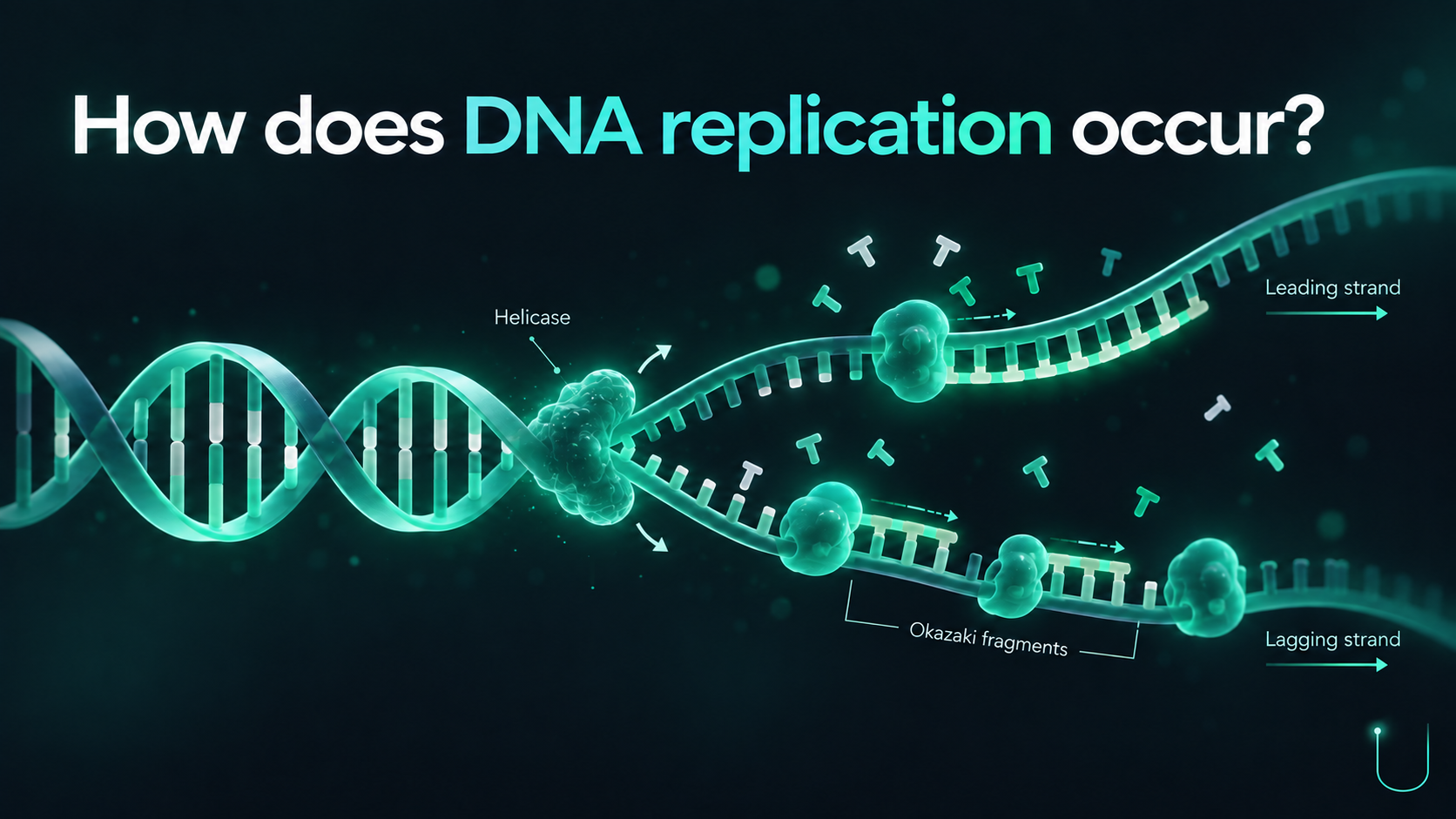
The lagging strand is different. It has to be synthesised in short sections as more of the DNA opens. These short pieces are called Okazaki fragments.
This is one of the parts of DNA replication that can be difficult to picture from text alone. Both strands are being copied at the same replication fork, but they are being constructed in different ways.
Seeing the replication fork move while the leading and lagging strands form can make this relationship much easier to follow.
5. DNA ligase joins the fragments#
The Okazaki fragments on the lagging strand eventually need to become one continuous DNA strand. An enzyme called DNA ligase joins these fragments together by sealing the gaps between them. By the end of this process, both newly synthesised strands form complete DNA molecules alongside their original template strands.
The result is two DNA double helices, each containing one original strand and one newly formed strand. That is why DNA replication is called semi-conservative.
What are the main enzymes involved in DNA replication?#
Several proteins work together during replication, but these are some of the key ones to remember:
| Enzyme | Main role |
|---|---|
| Helicase | Separates the two DNA strands |
| Topoisomerase | Relieves twisting stress as DNA unwinds |
| Primase | Creates primers that allow synthesis to begin |
| DNA polymerase | Adds complementary nucleotides to build new DNA |
| DNA ligase | Joins Okazaki fragments on the lagging strand |
These enzymes do not work as completely separate steps. At the replication fork, several proteins coordinate their activity to copy DNA efficiently and accurately.
Why is DNA replication difficult to understand from a static diagram?#
A diagram can show helicase, DNA polymerase, the leading strand, the lagging strand, and Okazaki fragments. But the real process is dynamic.
The helix is opening while new DNA is being created. One strand is being synthesised continuously, while the other is being produced in fragments. Primers appear, polymerases move, and ligase connects the pieces. All of that is happening as the replication fork continues to move.
That is why DNA replication animation can be particularly useful for this topic. Instead of trying to mentally connect several individual diagrams, you can watch the sequence happen as one process.
See DNA replication through a 3D animation#
This is where the textual explanation and the visual explanation can work together.
The concepts you have just read – the DNA opening, the template strands separating, complementary nucleotides being added, and new strands forming – become much easier to connect when you can see their movement and sequence.
We created a DNA replication 3D animation with UnStill to show the process visually. The purpose of the animation is not to replace the explanation above. It adds another layer to it.
You can first understand the terminology in text and then watch the same idea unfold in space and time. That makes it easier to connect individual terms such as helicase, DNA polymerase, nucleotides, and replication forks with the actual process they describe.
From reading DNA replication to seeing it happen#
When someone asks “How does DNA replication occur?”, the shortest answer is that the DNA double helix separates, each original strand acts as a template, and enzymes build complementary new strands. But understanding the full process means seeing how those steps connect.
The DNA replication animation above is one example of the kind of visual explanation that can be generated with UnStill from a topic that is usually taught through paragraphs and static diagrams.
Happy learning – and if a concept is difficult to picture, try seeing it move.